This refrain appears in the following chapters:
This refrain appears in the following chapters:
Gesture is promiscuous. It moves in multiple directions. As calls or as responses, a gesture ricochets off of precedent to inaugurate relation anew. Though the “hello” of a hand wave has been gestured countless times, each contingent call or response is a singularity, again. It may accompany sound, but can also stand on its own. It jumps body to body to body in transmission, like waves.
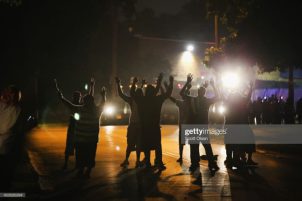
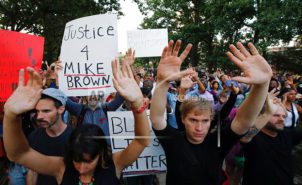
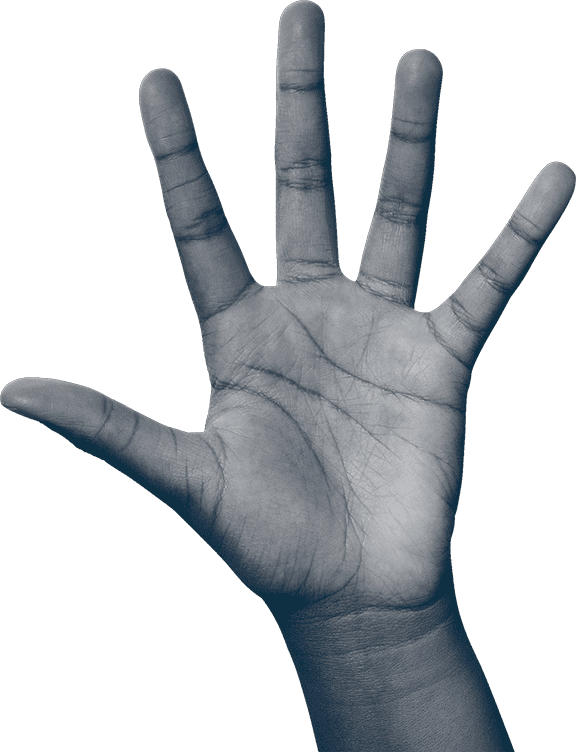
Embodied, a gesture of greeting might be a hand held up to welcome advance. But the same gesture might signal the inverse—Stop! A hand held up might say: I prefer not to. Or, Wait. The same gesture could pose a question or make a declaration. It might suggest that Here is the place, or that Now is the time. Or, Now is not the time! This is not the place! Arguably, attempts to pin gesture down to definitive meaning are attempts from which, as performances, they invariably escape, fugitive as well as (re)iterative. To use Sally Ann Ness and Carrie Noland’s word, gestures “migrate,” nevertheless dragging history along with them (2008).
Gestures carry calls that extend off of a body or thing and often re-irrupt as response. A gestural greeting of “Hello” bouncing off one body toward another may be re-embodied on the rebound to carry the same gesture in an inverse direction as response: “Goodbye.” Regardless of meaning, however, hands raised or otherwise moved into the space between one and another (whether human or non ) are hands extended. They are hands entered into “intra-action,” to use Karen Barad’s word (2003:810). They are performances bodying forth the entangled histories and potentialities of relation–even without determined or definitive signification.
Think simply again of a wave of a hand, taken up and repeated. If I wave to you, you, perhaps, respond by waving back. Regardless of what the wave may mean as a gesture, an interval is generated, and potentially crossed, via iteration. The so-called past and the so-called future meet and greet at the site of reiteration: hello, hey you there, hold it, stand back, move along, yes, no, hello. A gesture, like a wave, is at once an act composed in and capable of reiteration but also an action extended, opening the possibility of future alteration. The cut of repetition suggests: it is in the future that our pasts await us–awaiting our response, awaiting our revisions, or even awaiting our refusal–waiting for the rebound or the redress. But also, and concentrically, it is in the past that our futures can be found, nodding their greetings to try again to try again. Greeting and greeting recombine, at the site of potentials for difference, and though every greeting drags a specific and situated history with it, it simultaneously offers a possibility that response may bring difference, provoking, inviting, even promising change in multiple directions.
Also, as the end of this chorus: “hands” don’t have to be human — or hands at all! The Oxford English Dictionary defines gesture broadly as the “manner of carrying the body” and “movement of the body or any part of it.” Whose body? As poets know, anything can gesture. A crab gestures in a Mark Doty poem; frost gestures according to Rupert Brooke; Ann Waldman states that every single letter in the alphabet is a gesture; and, though not a poet, Sara Ahmed writes that certain theories “merely” gesture toward their arguments (as if gesture were weak or unfulfilling) (2009). Bu If theory can gesture, along with crabs, frost, and letters, then gesture need not be attached to a human body. And the whole world opens to tne vave form and its endless, beckoning complexities!
This refrain appears in the following chapters: